
You may notice your type 1 electric car charger does not keep up with your routine anymore. Charging times can feel much longer, especially if you have a new EV. Over the past five years, the average battery size of electric vehicles has increased by 167%. If daily charging now takes up too much time, you might need an upgrade. An upgrade helps when your driving needs change or your battery gets bigger.
Signs Your Type 1 Electric Car Charger Is Too Slow

Longer Charging Times Than Before
You may notice your charging time has increased. This happens when you use a type 1 electric car charger with a newer EV. Many modern electric vehicles have larger batteries. These batteries take much longer to charge with a basic charger. For example, a Level 1 charger can take over 40 hours to fully charge a large battery. A Level 2 charger can finish the same job in just 4 to 8 hours.
Here is a simple table to show the difference:
| Charging Level | Hours to Full Charge |
|---|---|
| Level 1 | 40-50+ hours |
| Level 2 | 4-8 hours |
If you spend days waiting for your car to charge, you may need an upgrade. Faster charging helps you get back on the road quickly.
Charging No Longer Fits Your Schedule
You might find that charging your car overnight does not give you enough range for your daily routine. This can disrupt your plans and cause stress. Many drivers upgrade their home chargers to avoid late-night trips to public stations.
- Upgrading to a Level 2 charger reduces charging time and adds 25-50 miles of range per hour.
- Your vehicle will be ready when you need it.
- You can reclaim time in your daily routine.
Tip: If you often wake up to a car that is not fully charged, consider a faster charger for more convenience.
Upgraded to a Newer EV with a Larger Battery
When you switch to a newer EV, you get a bigger battery and more range. This means you need a charger that can keep up. Level 2 chargers are preferred because they charge much faster than Level 1 chargers.
- Larger batteries provide more energy and improved technology.
- Level 2 charging stations can charge an EV up to ten times faster.
- A 40 kWh battery takes about 10 hours to charge with a 16 amp Level 2 charger, but only 6 hours with a 30 amp charger.
If your type 1 electric car charger cannot handle your new battery, you may need an upgrade. Faster charging supports your daily needs and keeps your EV ready for any trip.
Increased Daily Driving Distance
You may notice your daily driving distance has grown. This change can happen when you start a new job, move to a different area, or add more errands to your routine. If you drive farther each day, your type 1 charger might not keep up with your needs. You spend more time waiting for your car to charge, and you risk running out of power before your day ends.
Here are some signs that your charger cannot handle your new driving habits:
- You need to recharge your car more than once a day.
- You worry about having enough range for unexpected trips.
- You plan your schedule around charging times instead of your activities.
Note: If you drive longer distances, you need a charger that can deliver more energy in less time. Upgrading to a Level 2 charger helps you keep your ev ready for every journey.
A faster charger gives you peace of mind. You can charge your car quickly and spend more time on the road. You do not have to worry about missing important events or being late because your car is still charging. You gain flexibility and freedom to travel as far as you need.
Home Charging Challenges With Type 1 Chargers
Overnight Charging Limitations
You may notice that your car does not finish charging overnight. A type 1 electric car charger works slowly, especially with larger batteries. You might need more than 30 hours to fully charge your EV if you drive a lot. This slow speed can make it hard to keep your car ready for the next day. If you have a busy schedule, waiting for your car to charge can cause problems. You may feel frustrated when you cannot use your car in the morning.
- Slow charging means you get only 3 to 5 miles of range per hour.
- You may not have enough time to reach a full charge before you need your car again.
- Long charging times make it hard to plan for long trips or last-minute errands.
Tip: If you often wake up to a car that is not ready, you may want to think about a faster charging option.
Insufficient Range for Daily Commutes
You need enough range to get to work, school, or other places every day. Level 1 charging adds only a few miles each hour. If you have a long commute, this may not be enough. You might worry about running out of power before you get home. This can make you feel stressed and limit your travel plans.
- Long charging times do not fit well with busy lives.
- You may need to stop at public chargers during the day.
- Planning your day around charging can be difficult.
You want home charging to make your life easier, not harder.
Impact on Family or Shared Vehicle Use
Many families share one or more electric vehicles. Slow charging can cause problems when more than one person needs to use the car. You may have to wait for your turn to charge. This can lead to arguments or missed appointments. Older homes may not have enough electrical capacity for several chargers.
Here is a table that shows common challenges:
| Challenge/Concern | Description |
|---|---|
| Electrical Capacity | Retrofitting older buildings often faces limitations in electrical capacity, requiring significant upgrades to support multiple EV chargers. |
| Load Management | Concurrent use of several chargers can exceed the building’s electrical demand, leading to potential demand charges. |
| Solution | Load management functionality allows multiple chargers to operate on a single circuit, minimizing the need for extensive upgrades and optimizing charging times. |
You want everyone in your home to have access to a charged vehicle. Upgrading your charging setup can help your family avoid these problems.
Benefits of an Upgrade to a Level 2 EV Charger

Faster Charging Speeds
You notice a big difference in charging speed when you switch from a type 1 electric car charger to a level 2 EV charger. Level 1 charging gives you only 3 to 5 miles of range per hour. Level 2 charging boosts that number to 12 to 60 miles per hour. Most EVs reach a full charge in 5 to 8 hours with a level 2 charger, while a level 1 charger can take up to 43 hours.
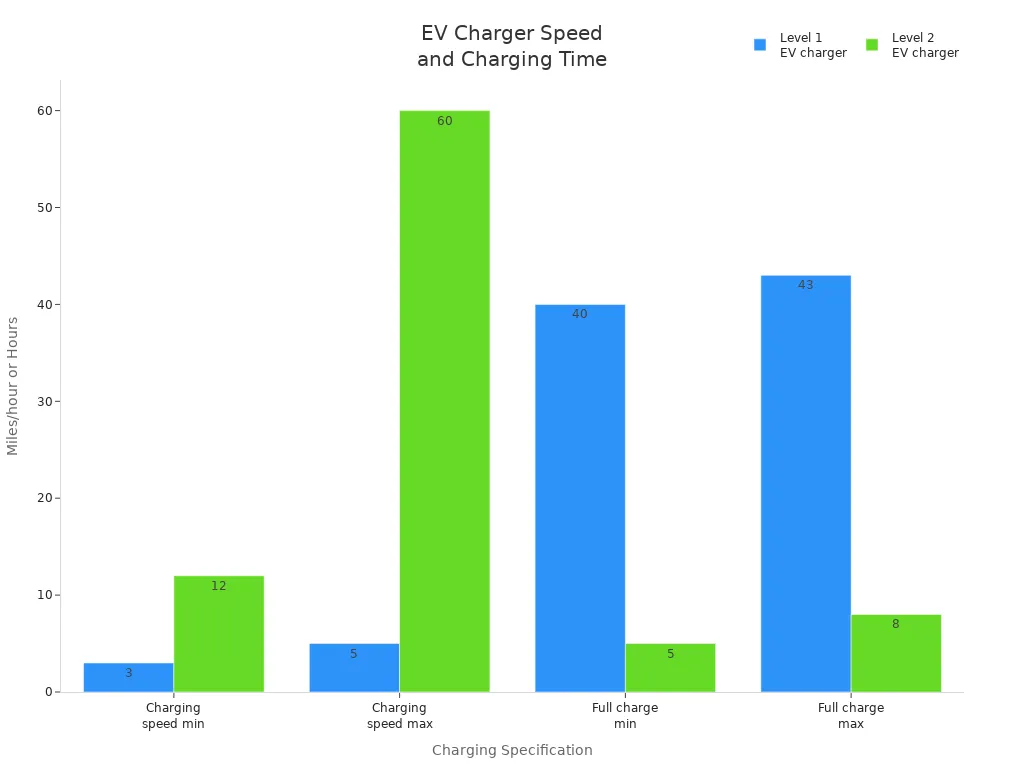

Here is a table that shows the difference:
| Specifications | Level 1 EV charger | Level 2 EV charger |
|---|---|---|
| Typical charging speed | 3-5 miles/hour | 12-60 miles/hour |
| Time to full charge (60 kWh) | 40-43 hours | 5-8 hours |
You save time every day. You do not need an upgrade as often, but when you do, the change is dramatic.
Improved Convenience and Flexibility
You gain more convenience with a level 2 charger. You can charge your EV at home and finish in just a few hours. You do not have to plan your day around charging. You wake up to a fully charged car, ready for your commute or errands.
- Level 2 charging makes home charging easier.
- You reclaim valuable time.
- You enjoy enhanced accessibility.
Tip: A professionally installed charger transforms your daily routine and makes EV ownership seamless.
Future-Proofing for New EVs
You prepare your home for future EVs when you install a level 2 charger. New models often have bigger batteries and need faster charging. Your home becomes more attractive to buyers as EV adoption grows.
- Level 2 chargers support new technology.
- Your home charging setup stays ready for upgrades.
- You add value to your property.
You make a smart investment that keeps your home and vehicle ready for the future.
Enhanced Home Value and Tech Compatibility
When you install a level 2 ev charger at home, you do more than just speed up your car’s charging. You also make your home more valuable and ready for new technology. Many home buyers look for modern features that make life easier. A home with a fast and reliable charging station stands out in today’s market.
Buyers want homes that support electric vehicles. They see a charging station as a sign that the house is up-to-date. If you ever decide to sell, you may find more people interested in your property. Some buyers even pay more for homes with built-in charging options.
A level 2 charger often needs an upgrade to your home’s electrical system. This upgrade can improve the safety and reliability of your entire house. You get better wiring and a stronger electrical panel. These changes help your home handle more devices and future technology.
Here are some ways a level 2 charger boosts your home’s value and tech compatibility:
- Attracts buyers who own or plan to own electric vehicles
- Shows your home is ready for modern living
- Improves your home’s electrical system for other smart devices
| Benefit | Description |
|---|---|
| Higher resale value | Homes with EV chargers sell faster and for more |
| Modern tech compatibility | Supports smart home upgrades and new appliances |
| Electrical infrastructure | Upgrades make your home safer and more reliable |
Note: Adding a level 2 charger is a smart investment. You prepare your home for the future and make it more appealing to buyers.
Deciding If a Charger Upgrade Is Worth It for Your EV
Assess Your Current and Future Charging Needs
You should start by looking at your daily driving habits. Think about how far you drive each day and how much time you have to charge your EV. If you find yourself waiting for your car to charge or planning your day around charging times, you may need a faster solution. Consider if your family will add another electric vehicle soon. A new car or a change in your routine can make your current charger too slow. Planning ahead helps you avoid frustration and keeps your EV ready for every trip.
Compare Costs and Installation Requirements
Upgrading to a Level 2 charger involves some costs. You will need to buy the charger, pay for installation, and possibly get permits. Here is a table that shows the typical price range:
| Component | Cost Range | Notes |
|---|---|---|
| Level 2 Charger Equipment | $400-$800 | Varies by brand and features |
| Installation Labor | $300-$800 | Depends on complexity and location |
| Electrical Materials | $150-$400 | Wire, breaker, conduit, outlet |
| Permits and Inspection | $50-$200 | Varies by jurisdiction |
| Total Typical Range | $899-$1,999 | Standard installation |
You may need a 240V electrical source. Sometimes, an electrical panel upgrade is required. This can cost between $1,500 and $3,000. If your home needs a service upgrade from 100A to 200A, the cost can range from $2,000 to $4,000. Charging at home during off-peak hours can save you over $1,500 each year compared to public charging. You get more convenience and lower costs in the long run.
Consider Compatibility with Your Vehicle and Home Electrical System
You need to make sure your new charger works with your car and your home. Check your electrical panel to see if it has enough capacity. A home with at least 200 amps and two empty slots for a double-pole circuit breaker usually supports a Level 2 charger. Even homes with 100 amps can sometimes handle a charger, depending on other electricity use. Ask an electrician to help you decide if you need an ev charger panel upgrade or load management system. Make sure the charger’s amperage matches your home’s capacity and follows safety codes. Choose a charger that is laboratory-safety certified. Always check your vehicle’s manual to see what kind of charge it can accept.
Tip: If your electrical panel is tight on space, you can use a lower-powered charger or talk to an electrician about circuit-sharing options.
Evaluate Available Incentives or Rebates
You can save money when you install a Level 2 electric car charger at home. Many programs offer rebates or tax credits to help with the cost. These incentives make it easier for you to upgrade your charging setup.
You may find rebates from your local utility, city, or state. Some programs cover part of the charger cost, while others help with installation or electrical panel upgrades. The federal government also offers a tax credit for home charging equipment. Here is a table that shows some popular programs and what they offer:
| Program Name | Rebate Amount | Eligibility |
|---|---|---|
| CALeVIP: Northern CA Incentive Project | Covers new, stub-out, replacement, or make-ready site | Humboldt, Shasta, and Tehama counties |
| Silicon Valley Power – EV charging station rebate | Up to $550 per charging station; additional $1,000 for panel upgrades | Residential installations |
| SCAQMD – Residential EV Charging Incentive Program | $250-$500 | Installation of level 2 EV charging station |
| Azusa Light & Water – EV Charger Rebate Program | $500 | Purchase and installation of Level 2 residential EV charging station |
| Austin Energy – Independent EV Charging Station Rebate | Up to $3,000 for Level 2 | Business, non-profit, or multi-family properties |
| Entergy – EV Charger Rebate Program | $250 | Level 2 residential EV charger installed |
| SWEPCO – Level 2 Home EV Charging Station Rebate Program | $250 | Level 2 residential EV charger installed |
| Duke Energy Indiana – Commercial Charger Rebate | $500 | Level 2 EV charging station installed in MUDs and workplaces |
| Liberty EV Charger Rebate Program | Up to $2,500 for commercial units | Small Business installations |
| IRS: Federal Tax Credit for Electric Vehicle Charging Equipment | Up to $1,000 | Qualified vehicle refueling and recharging property at home |

You should check with your local utility or city website to see what is available in your area. Some programs change often, so look for the latest information before you buy a charger.
Government policies also help you with your decision. The federal government gives money to support home charging. A $5 billion investment in the National Electric Vehicle Infrastructure project helps build more chargers across the country. Safety and efficiency rules make sure your installation is reliable. Here is a quick look at how these policies work:
| Mechanism | Description |
|---|---|
| Financial Incentives | The federal government provides funding to support the installation of EV chargers, encouraging homeowners to adopt them. |
| Infrastructure Development | A $5 billion investment in the National Electric Vehicle Infrastructure project aims to enhance the availability of chargers. |
| Regulatory Standards | Requirements for safety and efficiency ensure that installations meet certain criteria, promoting reliability for users. |
Tip: You can lower your out-of-pocket costs by using rebates and tax credits. This makes your upgrade more affordable and helps you get the most value from your investment.
Common Upgrade Options for Home Charging
Overview of Level 2 EV Charger Types
You have several choices when you decide to upgrade your home charging setup. Most level 2 EV chargers use 240-volt power, similar to what a clothes dryer needs. These chargers require a dedicated circuit and professional installation. Charging time with level 2 charging usually takes four to ten hours for a full charge. Plug-in hybrids can finish charging in one to two hours. Many chargers offer smart features that help you monitor energy prices and schedule charging for off-peak hours. Some models connect with home storage systems, which can lower your charging costs.
- Choose a lower-powered charger, like a 16-Amp model, if your electrical panel has limited capacity.
- Ask an electrician about load management or circuit-sharing systems to make the best use of your electricity.
- Plan for future needs if you might charge more EVs or switch to electric appliances.
What to Look for in a New Charger
When you select a new charger, you should think about your charging speed needs. Level 2 chargers work well for longer stays at home. Make sure your electrical system can support the charger for safe installation. Look for features that make charging easy and secure.
| Feature | Description |
|---|---|
| Power output | Matches your daily routine and panel capacity |
| Durability | Handles weather and physical impacts |
| User experience | Easy to use and access |
| Network capabilities | Lets you monitor and manage charging |
| Safety features | Certified for safety standards |
You can also find chargers that adjust the maximum amps, share power with other devices, track energy use, and prevent unauthorized access.
Tip: Scheduling charging for off-peak rates can save money and reduce stress.
Professional Installation Tips
You should always work with a licensed electrician who knows EV installations. Hardwiring your charger improves security and durability. High-quality materials, like copper wiring, help your charger last longer and stay safe. The installation process includes permit approval, construction, and inspection. Permit approval takes two to four weeks. Installation and construction usually take one to three weeks. Testing and inspection add about one week.
| Phase | Duration |
|---|---|
| Permit Approval | 2–4 weeks |
| Installation and Construction | 1–3 weeks |
| Testing, Commissioning, and Inspection | ~1 week |
Note: Planning ahead makes your upgrade smooth and ensures your level 2 EV charger works safely and efficiently.
You may find that your type 1 electric car charger no longer fits your routine. Upgrading can save you hours each week and make home charging much easier. For example, a level 2 charger can charge a 60 kWh battery in 5-8 hours, while a level 1 charger takes 40-43 hours.
| Charger Type | Time to Full Charge (60 kWh) |
|---|---|
| Level 1 EV Charger | 40-43 hours |
| Level 2 EV Charger | 5-8 hours |
If you need an upgrade, take action now to enjoy faster charging and a more flexible schedule.
FAQ
How do I know if my home can support a Level 2 charger?
You should check your electrical panel for available space and capacity. Most homes need a 200-amp panel for a Level 2 charger. Ask a licensed electrician to inspect your setup before you buy a new charger.
Will a Level 2 charger work with all electric vehicles?
Most Level 2 chargers use a standard connector called J1772. You can use this with almost every EV sold in North America. Some vehicles, like Teslas, need an adapter. Always check your car’s manual for compatibility.
How much faster is Level 2 charging compared to Level 1?
Level 2 charging adds 12 to 60 miles of range per hour. Level 1 charging adds only 3 to 5 miles per hour. You can fully charge most EVs overnight with Level 2 charging.
Do I need a permit to install a Level 2 charger at home?
In most cities, you need a permit for electrical work. This keeps your installation safe and up to code. Your electrician can help you get the right permits before starting the job.


