
The SAE J1772 connector is the North American standard for electric vehicle charging. You will use this plug for your EV’s daily power needs. This includes both Level 1 charging and faster Level 2 charging.
Note: Think of this connector as a universal charger for your EV. It allows you to plug into a vast network of home and public charging stations, simplifying your Level 2 charging routine.
Understanding Level 1 and Level 2 Electric Vehicle Charging
Your electric vehicle charging needs will change based on your daily driving and available equipment. The two main AC charging methods are Level 1 and Level 2. Each offers a different balance of speed, cost, and convenience.
Level 1: Charging with a Standard Outlet
Level 1 charging is the simplest way to power your ev. It uses a standard 120-volt wall outlet, the same kind you use for a lamp or a laptop. Most electric vehicles come with a Level 1 cordset, so you can start charging right away without any special installation.
These chargers deliver power slowly. They typically provide between 1.3 kW and 2.4 kW. This output adds about 4 to 6.5 miles of driving range for every hour you are plugged in. While slow, level 1 charging is perfect for certain situations.
When is Level 1 a good fit? You might find it works well if you:
- Drive less than 40 miles per day and can charge overnight.
- Own a plug-in hybrid (PHEV) with a smaller battery.
- Live in a rental or apartment where you cannot install a faster charger.
- Want a backup charging option when visiting friends or family.
Level 2: The Most Common Charging Speed
Level 2 charging is the most common and practical method for daily EV ownership. It uses a 240-volt circuit, similar to an electric dryer or oven. You can find Level 2 chargers at public stations, workplaces, and installed in home garages.
This method significantly reduces your charging time. Level 2 charging stations provide a wide range of power, from 6.2 kW up to 19.2 kW. However, most home and public chargers you will encounter deliver between 3.3 kW and 7.2 kW. This speed can add 20-30 miles of range per hour, fully charging most EVs overnight. Because of its balance of speed and cost, level 2 charging is the go-to solution for most drivers. Upgrading your home for level 2 charging prepares you for a seamless ownership experience.
What is the SAE J1772 Connector?

The sae j1772 connector is the key to Level 1 and Level 2 charging in North America. You will become very familiar with this plug. It is a well-designed piece of technology that makes charging safe and simple. Understanding its parts helps you appreciate the engineering behind your daily charging routine.
The Universal Plug for Your EV
Think of the J1772 as the universal plug for your electric vehicle. SAE International, a professional standards organization, maintains the technical standards for this connector. Its history began in 2001. The California Air Resources Board (CARB) first adopted these charging standards. This decision created a single, reliable plug for all automakers to use. This move prevents confusion and ensures your ev can connect to a wide network of chargers. These universal standards make public charging much easier for everyone.
How the J1772 Connector Works
The J1772 plug looks simple, but it has five pins that perform specific jobs. Each pin plays a role in a “digital handshake” between your car and the charger. This process ensures a safe and efficient flow of power. These communication standards are vital for safety.
- AC Line 1 (L1) & AC Line 2/Neutral (L2/N): These two large pins deliver the electricity. For Level 1 charging, one pin is “hot” and the other is “neutral.” For Level 2 charging, both pins are “hot” to provide 240-volt power.
- Protective Earth (PE): This is a critical safety ground pin. It works like the third prong on a home appliance plug. It protects you from electrical faults.
- Proximity Pilot (PP): This pin tells your car that a plug is connected. It also prevents you from driving away while charging. When you press the handle’s latch to unplug, it signals the car to stop the power flow before the main pins disconnect. This action prevents dangerous sparks. The pin also checks the cable’s maximum current capacity using a resistor. This is one of the most important safety standards.
- Control Pilot (CP): This pin is the “brain” of the operation. It sends a signal from the charging station to the car. This signal tells your vehicle the maximum amount of power available. Your car then signals back when it is ready to charge. This two-way communication manages the entire charging session safely.
How does the charger know the cable’s limit? The Proximity Pilot pin uses different resistance values to tell the car the cable’s maximum amperage. This ensures the car never tries to pull more power than the cable can safely handle. These resistance standards are set by the industry.
Current Rating Resistance Value 13A 1500 Ω 20A 680 Ω 32A 220 Ω 70A 100 Ω 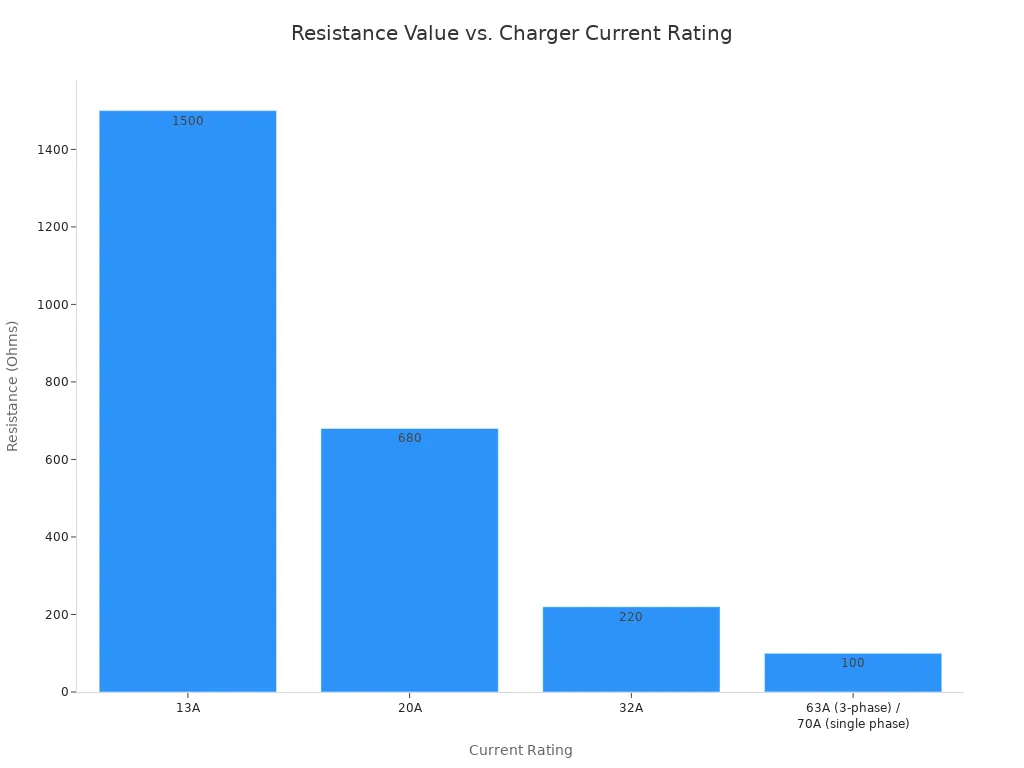
The Control Pilot pin communicates the station’s maximum available current using a special signal called Pulse Width Modulation (PWM). The duty cycle, or “on-time” of this signal, tells the car how much power it can draw. For example, a short duty cycle means less power is available, while a long one means more power is ready.
Vehicle Compatibility
In North America, the sae j1772 connector is the standard for AC charging on almost every electric vehicle. The main exception is Tesla. If you drive an EV from Ford, GM, Rivian, Hyundai, Kia, Volkswagen, or nearly any other brand, your car has a J1772 inlet. This widespread adoption means you can confidently use most public Level 2 charging stations without needing an adapter.
How to Charge Your EV with a J1772 Connector

You can use the SAE J1772 connector in two main settings: at home or at public stations. Each offers a different experience for powering your EV.
Charging at Home
Charging your electric vehicle at home is the most convenient and cost-effective option. While Level 1 charging works, upgrading to Level 2 charging will fully charge your EV overnight. Installing the necessary Level 2 equipment involves a few steps.
- Assess Your Home: An electrician must check if your electrical panel can support a new 240-volt circuit.
- Purchase an EVSE: You will need to buy a Level 2 charger, also known as an Electric Vehicle Supply Equipment (EVSE). These home wall chargers typically cost between $400 and $700.
- Hire an Electrician: A professional must perform the installation. Costs can range from $500 to over $2,000, depending on the complexity of the job.
Tip: You may qualify for a federal tax credit of 30% (up to $1,000) for the cost of your charger and its installation. This can make your Level 2 charging upgrade more affordable.
Using Public J1772 Chargers
You will find Level 2 charging stations at workplaces, shopping centers, and hotels. This public charging infrastructure makes it easy to top off your battery while you are out. Major networks include ChargePoint and Blink.
To use these public charging stations, you typically need an account with the network provider. Payment methods often include:
- A mobile app
- An RFID card linked to your account
- A credit card reader on the charger
When using a shared charger, remember good etiquette. Only occupy the spot while you are actively charging. Once your session is complete, move your vehicle so others can use the station. This simple courtesy helps everyone in the EV community.
J1772 vs. Other EV Connectors
Your J1772 plug handles daily charging, but you will see other connectors in the EV world. Different plugs exist for different regions and charging speeds. Understanding them helps you know what to expect at various charging stations.
AC Charging (Level 1 & 2)
The J1772 is the standard for AC power in North America. You will use it at all public Level 2 j1772 charging stations. Europe uses a different plug called the Type 2, or Mennekes, connector.
- J1772 (North America): This round, five-pin plug handles single-phase power. It is the universal connector for all non-Tesla EVs at j1772 charging stations.
- Type 2 (Europe): This seven-pin plug can handle both single-phase and three-phase power. This design allows for faster AC charging in regions that support it.
The J1772 charger can deliver up to 19.2 kW, which is plenty for home and public j1772 charging stations. The network of j1772 charging stations is extensive across the continent.

DC Fast Charging (CCS, NACS)
DC fast charging is for long road trips. It uses different, more powerful connectors than the ones at j1772 charging stations. Your car’s charge port will have extra pins below the J1772 inlet for this purpose.
What is CCS? The Combined Charging System (CCS) is a popular standard. It cleverly adds two large DC pins below the standard J1772 plug. This allows you to use one port for both AC charging at j1772 charging stations and DC fast charging. This type of charger can deliver speeds up to 350 kW.
The other major standard is the North American Charging Standard (NACS), developed by Tesla. It is a smaller, single plug that handles both AC and DC charging. Most automakers, including Ford, GM, and Hyundai, have announced they will adopt the NACS plug for future models starting in 2025. This means you will see fewer CCS plugs over time. NACS and CCS chargers offer similar top speeds, but the NACS network is currently larger. You will still find many j1772 charging stations for your daily needs. The availability of j1772 charging stations will not change. Your ev will still rely on j1772 charging stations for Level 2 power.
The sae j1772 connector is your key to daily electric vehicle power. Since most drivers charge at home, mastering home level 2 charging is essential for a seamless experience. You will also use this plug for public level 2 charging while you are out and about. For faster road trips, your EV uses different plugs like CCS or NACS. Understanding your options for level 2 charging ensures you can power your vehicle with confidence wherever you go.
FAQ
Can I use a J1772 charger for my Tesla?
Yes, you can. Tesla vehicles include a J1772 adapter. You connect this small adapter to the J1772 plug first. Then, you can plug it into your car. This gives you access to thousands of public Level 2 charging stations.
What determines my charging speed?
Your charging speed depends on two things: the station’s power output and your car’s charging limit. Your EV will always charge at the slowest of the two rates. For example, your car will not charge faster than its own limit, even at a powerful station.
Is it safe to charge my EV in the rain? 🌧️
Yes, charging your EV is completely safe in the rain. The J1772 connector and your car’s port are waterproof. The system runs safety checks before power begins to flow. This design prevents any risk of electric shock, so you can charge with confidence.
Will my J1772 car become obsolete with NACS?
No, your car will not become obsolete. The J1772 charging network is very large and will be supported for many years. Adapters will also allow J1772 cars to use NACS stations. You will have plenty of charging options for the life of your vehicle.


