
You see the portable EV charger market changing how you drive and charge your vehicle. Portable electric vehicle chargers give you more freedom and help you worry less about running out of battery. Many drivers use home charging, but portable solutions make charging easier when you travel. The market reached about USD 1.2 billion in 2024, and experts expect it to grow to USD 4.8 billion by 2033.
Smart technology and better batteries help you charge your vehicle faster. More portable electric vehicle charger market options support sustainability and improve charging infrastructure for everyone.

Portable EV Charger Market Growth and Future Projections
Current Market Size and Growth Rates
You see the portable EV charger market expanding quickly across the globe. In 2024, the global market reached about USD 4.11 billion. This number shows how much people want flexible charging solutions for their electric vehicles. The portable electric vehicle charger market has grown because more drivers choose electric cars for daily use and travel. You notice significant growth in electric vehicle sales, which pushes the need for portable chargers even higher. Industry insights reveal that the market will keep growing as new technologies make charging easier and faster.
Key Drivers of Market Growth
Many factors drive the significant growth in the portable EV charger market.
- Rapid adoption of electric vehicles worldwide increases the demand for battery electric vehicles and portable charging options.
- You need accessible and flexible charging solutions because fixed charging stations are not always available.
- Technological innovations, such as fast charging and smart connectivity, improve the portable electric vehicle charger market.
- Supportive government policies, including subsidies, tax rebates, and emission norms, encourage you to switch to electric mobility.
- Urbanization and environmental awareness make you look for sustainable transportation.
- Shared mobility and commercial fleet operations require scalable charging solutions.
- Advanced features like IoT and compatibility with different vehicle models make portable chargers more attractive.
- Regional government initiatives, especially in Asia Pacific and North America, help the market grow faster.
Tip: You can benefit from government incentives like tax credits and rebates when you buy an electric vehicle or install a charger. These policies make it easier for you to adopt new technology and help the environment.
Forecasts for 2025 to 2030
You will see significant growth in the portable EV charger market over the next few years. Experts predict the market will reach USD 12.35 billion by 2030. The compound annual growth rate (CAGR) will be about 19.3% from 2025 to 2030. This strong market growth means you will have more choices and better technology for charging your electric vehicle.
Here is a table showing the expected CAGR for different regions and segments:
| Region/Segment | CAGR (%) | Period |
|---|---|---|
| Global Market | 21.7 | 2024-2030 |
| China | 20.5 | 2024-2030 |
| Germany | 14.7 | 2024-2030 |
| U.S. | 20.1 | 2024-2030 |
| Japan | 20.1 | 2024-2030 |
| Canada | 18.5 | 2024-2030 |
| Gas-Fueled Charger | 23.5 | 2024-2030 |
| Battery EV Charger | 17.0 | 2024-2030 |

You can expect the portable electric vehicle charger market to keep growing as more people choose electric vehicles and as technology improves. Market dynamics will change as new policies and innovations appear. The future looks bright for portable charging solutions, and you will see more options that fit your needs.
Technological Innovations in the Portable Electric Vehicle Charger Market

AI Integration and Smart Charging Solutions
You see artificial intelligence changing how you charge your electric vehicle. AI helps portable electric vehicle chargers work smarter and faster. These chargers use real-time data to adjust power delivery based on grid demand. You benefit from predictive maintenance, which means the charger can detect problems before they happen. This reduces downtime and keeps your charger working longer.
AI-driven mobile apps let you monitor charging progress from your phone. You can track your battery status, find nearby charging stations, and control charging remotely. Machine learning helps balance the load on the grid, preventing overloads and improving stability. You also get better security because AI can stop unauthorized access and protect against voltage spikes.
Tip: Smart charging solutions allow you to schedule charging during off-peak hours, saving money and helping the environment.
Smart charging solutions improve grid management and user experience. You see features like remote monitoring, scheduled charging, and integration with smart home systems. IoT capabilities let your charger communicate with your vehicle and the grid, optimizing energy use and cost. Ultra-fast charging technology reduces wait times, meeting the growing demand for fast charging. Bi-directional charging lets your vehicle send electricity back to the grid, supporting grid stability and creating new ways to save money.
- AI optimizes charging efficiency by adjusting power delivery based on real-time grid demand.
- Predictive maintenance capabilities allow early detection of potential charger failures, reducing downtime.
- Machine learning enables dynamic load balancing to prevent grid overloads.
- AI-driven mobile apps enhance user experience by enabling remote monitoring, charging progress tracking, and locating nearby stations.
- Integration with renewable energy sources like solar and wind enables sustainable charging and reduces grid dependency.
- Bidirectional charging technology allows EVs to return electricity to the grid, aiding grid stability during peak demand.
- Smart grid integration enables chargers to communicate with grid operators to adjust charging rates dynamically, improving energy distribution efficiency.
Advances in Battery and Power Management
You notice big changes in battery technology for portable electric vehicle chargers. Manufacturers now use lithium iron phosphate (LFP) batteries because they charge faster and cost less to make than older nickel cobalt manganese (NCM) batteries. LFP batteries help you charge your vehicle quickly, but they have lower energy density and shorter range.
Solid-state batteries are another exciting innovation. These batteries promise longer driving ranges, shorter charging times, and better safety. You will see portable chargers become more reliable and efficient as solid-state technology improves.
- Lithium iron phosphate (LFP) batteries offer faster charging and lower costs.
- Solid-state batteries promise greater driving range, shorter charging times, and enhanced safety.
- Investments in battery technology make mobile charging solutions more practical and affordable.
Smart charging solutions also improve power management. You can charge your vehicle during periods of high renewable energy availability, reducing carbon emissions and saving up to 70% on charging costs. Dynamic load management helps balance energy use, preventing grid congestion and reducing peak demand.
Enhancements in User Experience
You want portable electric vehicle chargers that are easy to use and reliable. Recent models offer high charging capacity, often between 40 kW and 50 kW, so you spend less time waiting. Portability means you can take your charger anywhere, making it perfect for travel or emergencies. Chargers now support multiple connector types, including CCS2, so you can use them with buses, trucks, vans, and passenger cars.
Manufacturers design chargers to work in harsh environments. You get durable construction and weatherproof features, so your charger works in rain or snow. Wi-Fi integration lets you monitor charging remotely, adding convenience and security. Fleet operators benefit from chargers that can move between locations, improving efficiency and reducing costs.
| Feature | Description |
|---|---|
| Compatibility with single-phase and three-phase power | Enables use in diverse power environments including remote and rural areas, expanding usability |
| Modular design | Allows easier maintenance and upgrades, enhancing convenience and longevity |
| Support for multiple charging standards (CCS1, CCS2, CHAdeMO, GB/T, NACS) | Ensures broad vehicle compatibility, improving user flexibility |
| Portability | Compact and lightweight design fits easily in vehicle trunks, facilitating transport and on-the-go charging |
| Emergency charging capability | Provides immediate power solutions in challenging locations, enhancing reliability |
| Cost-effectiveness | Reduces infrastructure and maintenance expenses, making charging more affordable |
| Safety and compliance | Rigorous safety testing and adherence to international standards ensure reliable and safe operation |
| High stability and durability | Reliable performance in diverse environments, supporting rugged use cases |
You see user satisfaction scores rising for Level 2 portable chargers. These chargers offer higher power and more features than Level 1 models. You get better performance and more convenience, which makes portable electric vehicle chargers a popular choice.
| Charger Type | User Satisfaction Score (out of 1000) |
|---|---|
| Level 1 Portable Chargers | 581 |
| Level 2 Portable Chargers | 714 |
| Level 2 Permanently Mounted | 733 |
Note: Level 2 portable chargers provide a good balance between speed, portability, and user satisfaction.
Portable EV Charger Market Segmentation
By Charger Type (AC, DC, Fast, Ultra-Fast)
You can choose from several types of portable EV chargers. Each type offers different speeds and features. Fast chargers lead the market, making up about 58% of total revenue in 2024. Level-2 AC chargers dominate the U.S. manufacturing market. DC fast chargers and ultra-fast chargers are growing quickly because you want faster charging for your vehicle. Ultra-fast chargers, with power output above 151 kW, show the fastest growth and represent the newest technology.
| Charger Category | Market Share / Key Insight |
|---|---|
| Fast Chargers | Approximately 58% of total revenue in 2024 |
| Slow Chargers (AC Level 1 & 2) | Significant but less dominant than fast chargers |
| Level-2 (AC) Chargers | Dominated U.S. EV charger manufacturing market share in 2024 |
| Level-3 (DC Fast Charging) | Considerable share; includes fast and ultra-fast chargers |
| Ultra-Fast Chargers (>151 kW) | Fastest growth segment; represents cutting-edge technology |
Charging speed and compatibility matter when you select a charger for your vehicle. AC chargers work well for home and workplace use. DC fast chargers suit commercial and highway settings. Portable chargers offer flexibility but usually charge slower than fixed charging stations.
By Application (Residential, Commercial, Emergency, Fleet)
You use portable EV chargers in many ways. Residential users rely on them for emergency backup and for homes without dedicated charging infrastructure. Commercial users need portable chargers for business fleets and company car schemes. Emergency applications include roadside assistance and temporary charging during events. Fleet operators use mobile chargers to extend the range and reliability of their vehicles.
- Roadside assistance helps stranded vehicles get back on the road.
- Temporary charging services support high-demand events.
- Commercial fleets use portable chargers to improve service and reduce downtime.
- Remote area support brings charging to places without charging stations.
| Setting | Common Applications | Examples / Details |
|---|---|---|
| Residential | Emergency backup; for drivers without off-street parking | ZipCharge Go subscription; The Charge Scheme |
| Commercial | Fleet operations; business users | Kempower Movable Charger; SparkCharge Roadie |
| Emergency | Roadside help; event support; rural charging | RAC’s EV Boost; ZPN Energy’s ZAPME |
| Fleet | Extending range; improving reliability | Mobile charging units for fleet vehicles |
You see demand for portable chargers rising in all these segments. Residential users want convenience. Commercial and fleet users need efficiency. Emergency services value quick response and flexibility.
By Region
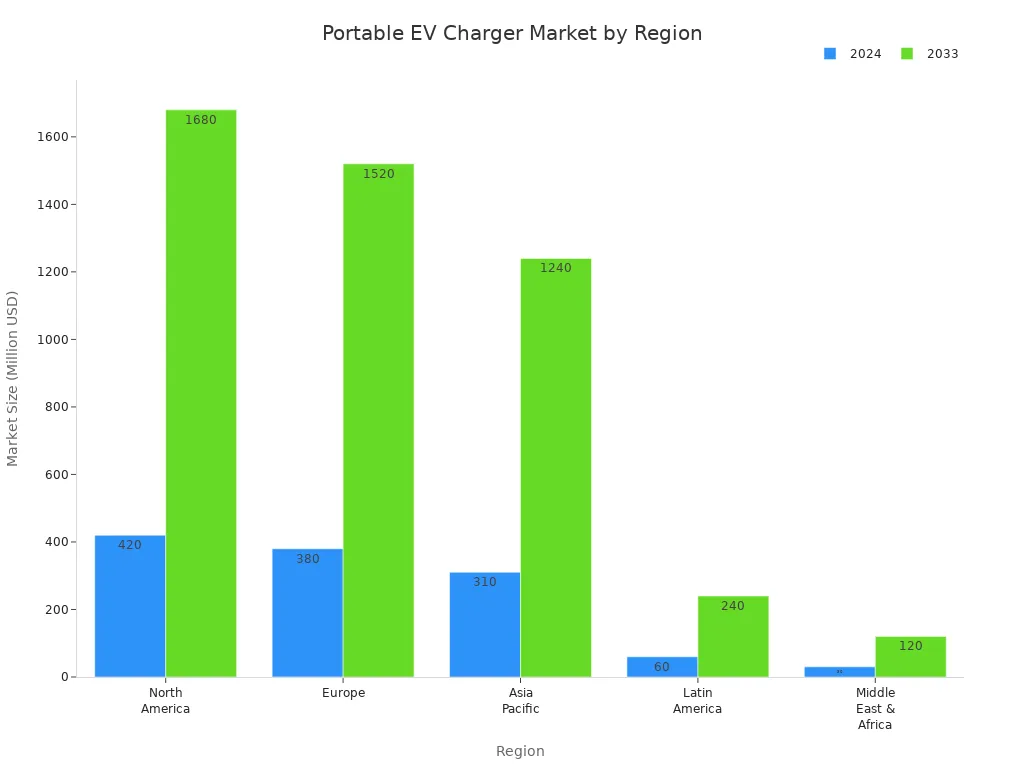
You notice that demand for portable EV chargers varies by region. North America holds the largest market share, with steady growth in the United States and Canada. Europe shows strong growth, led by Germany, France, and the UK. Asia-Pacific is the fastest-growing region, with China and Japan driving rapid adoption. Latin America and Southeast Asia are emerging markets, with Mexico, Brazil, and India showing rising demand.
| Region | Market Size Trend (2020-2031) | Market Share Insights |
|---|---|---|
| North America | Steady YoY growth | Largest market share; US and Canada key contributors |
| Europe | Strong YoY growth | Germany, France, UK lead market share |
| Asia-Pacific | Rapid growth projected | China and Japan dominate; fastest growing region |
| Latin America | Emerging growth | Mexico and Brazil show rising market share |
You see regional differences in charging infrastructure and vehicle adoption. Asia-Pacific leads in new energy vehicle sales. Europe pushes for more sustainable transportation. North America invests in expanding charging stations and portable solutions.
Tip: You can find portable EV chargers that fit your needs, no matter where you live or drive. Regional trends help you understand which solutions work best in your area.
Regional Trends in the Portable EV Charger Market

North America
You see North America leading the way in portable EV charger adoption. Many drivers choose portable chargers for convenience, especially if you live in an apartment or lack a dedicated home charging spot. You notice new technology like wireless charging and ultra-fast charging, which can fill your battery up to 80% in just 20 minutes. Smart connectivity lets you monitor charging from your phone, making the process easier.
Government policies help you save money and encourage you to buy electric vehicles. The Infrastructure Investment and Jobs Act and the Inflation Reduction Act support EV infrastructure and offer purchase incentives. These programs aim for half of new vehicle sales to be electric by 2030. You benefit from rebates and subsidies that lower costs and make portable chargers more affordable.
Manufacturers focus on making chargers more durable and compatible with different vehicles. You see more compact and mobile chargers, which work well in urban areas. Companies like ChargePoint, Tesla, and ABB compete to offer smart charging solutions. Seasonal demand spikes, especially in spring, show how much you rely on portable chargers for travel and emergencies.
Tip: You can use portable chargers to extend your driving range and reduce worries about finding a charging station.
Europe
You find Europe pushing for cleaner transportation and strong sustainability goals. Many countries invest in renewable energy and support electric mobility. You see portable EV chargers used in cities and rural areas, helping drivers who travel long distances. European governments set strict emission targets and offer incentives for EV adoption.
Charging infrastructure grows quickly in places like Germany, France, and the UK. You notice more public charging stations and portable solutions for homes and businesses. Companies focus on interoperability, making sure chargers work with many vehicle models. You benefit from smart charging features, such as remote monitoring and energy optimization.
A table shows key trends in Europe:
| Country | Main Focus | Notable Trend |
|---|---|---|
| Germany | Sustainability | Rapid charger deployment |
| France | Urban mobility | Smart charging integration |
| UK | Emission reduction | Fleet electrification |
Asia-Pacific
You see Asia-Pacific as the fastest-growing region for portable EV chargers. China and Japan lead in electric vehicle sales, driving demand for flexible charging options. Many cities invest in new energy vehicles and expand charging networks. You notice portable chargers used for both residential and commercial purposes.
Manufacturers in Asia-Pacific focus on affordability and high-speed charging. You find chargers that support multiple standards, making them suitable for different vehicles. Governments promote EV adoption through subsidies and infrastructure projects. You benefit from innovations like solar-powered chargers and mobile charging units for fleets.
Urbanization increases the need for portable solutions, especially in crowded cities. You see more companies entering the market, offering products that fit your lifestyle and travel needs.
Middle East and Africa
You see the portable EV charger market starting to grow in the Middle East and Africa. Many countries in this region focus on energy innovation and sustainability. Governments invest in electric mobility to reduce pollution and support clean energy goals. You notice cities like Dubai and Cape Town leading the way with new charging stations and pilot projects.
You find that portable chargers help drivers in remote areas. Fixed charging stations are not always available, so mobile solutions make electric vehicles more practical. Oil-rich countries like Saudi Arabia and the United Arab Emirates want to diversify their energy sources. You see them supporting electric vehicle adoption with incentives and public awareness campaigns.
Here is a table showing key trends in the region:
| Country | Main Focus | Market Trend |
|---|---|---|
| UAE | Smart cities | EV infrastructure growth |
| Saudi Arabia | Energy transition | Incentives for EV adoption |
| South Africa | Urban mobility | Pilot charging projects |
You notice challenges in this region. Charging infrastructure is limited in rural areas. High temperatures affect battery performance. You see companies working to design chargers that can handle extreme weather. You benefit from new solutions that improve reliability and safety.
Tip: You can look for portable chargers with weatherproof features if you drive in hot or dusty environments.
Latin America
You see Latin America moving toward electric mobility at a steady pace. Many cities face air pollution and traffic problems. Governments encourage you to use electric vehicles by offering tax breaks and subsidies. You notice Brazil, Mexico, and Chile leading the region in EV adoption.
Portable EV chargers help you charge your vehicle in places where public stations are rare. You find mobile charging units used at events, in fleets, and for roadside assistance. Companies focus on affordability and easy transport. You see more products designed for local needs, such as compact chargers for motorcycles and scooters.
Here are some important trends in Latin America:
- Brazil invests in renewable energy and supports EV infrastructure.
- Mexico expands its charging network in urban areas.
- Chile promotes electric buses and public transport.
You face some challenges in Latin America. Charging infrastructure grows slowly in rural regions. Power outages can affect charging reliability. You see manufacturers improving battery technology to handle these issues. You benefit from new partnerships between local companies and global brands.
Note: You can check for government incentives when you buy an electric vehicle or charger. These programs help you save money and support clean transportation.
Competitive Landscape of the Portable EV Charger Market
Leading Companies and Market Share
You see many companies competing in the portable EV charger market. Some focus on the U.S. Level 3 charger segment, while others lead globally. The following tables show top companies in both areas:
| Top Companies in the U.S. Level 3 Portable EV Charger Market |
|---|
| SparkCharge |
| Blink Charging |
| FreeWire Technologies |
| JTM Power Limited |
| Leading Companies in the Portable EV Charger Market (Global) |
|---|
| EcoFlow UK |
| Power Sonic Corporation |
| Blink Charging Co. |
| Heliox Energy |
| Shenzhen SETEC Power Co. Ltd. |
| Guangzhou Electway Technology Co. Ltd |
| JTM Power Limited |
| ZipCharge Limited |
| Evteq Mobility Private Limited |
| SparkCharge |
| FreeWire Technologies Inc. |
| EV Adept |
| Besen International Group Co. Ltd |
| Shell plc |
| Lectron EV |
You notice that these companies offer different products and services. Some focus on fast charging, while others provide affordable options or smart integrations.
Key Strategies and Partnerships
You see companies using several strategies to grow and compete.
- Many form partnerships to expand their reach and offer new products.
- Some target new regions, especially Asia-Pacific, to find more customers.
- You benefit from smart charging technologies, such as integration with smart home systems and mobile apps.
- Companies improve charging speed, durability, and portability.
- Government incentives and regulations help companies grow and encourage you to buy EVs.
- Mergers and acquisitions allow larger companies to buy smaller ones, increasing competition and innovation.
Recent mergers and acquisitions have changed the market. Larger companies now offer more products and reach more customers. This trend helps you get better chargers and more choices.
Tip: You can look for brands that offer strong warranties and customer support. These features make your charging experience easier and safer.
Emerging Startups and Innovators
You see new startups entering the portable EV charger market. These companies bring fresh ideas and new technology. Many focus on smart charging, improved battery life, and easy-to-carry designs. Startups often work with bigger companies to create better products and reach more users.
Innovators help you by making chargers that work in extreme weather, support many vehicle types, and connect with smart devices. You benefit from their focus on user-friendly features and affordable prices. As more startups join the market, you get more options and better technology for your electric vehicle.
Opportunities and Challenges in Portable EV Charger Market Growth
Market Opportunities for Stakeholders
You can find many market opportunities in the portable EV charger industry. As more people drive electric vehicles, you see a growing need for flexible charging solutions. This demand creates new ways for you and other stakeholders to benefit.
- You notice more mobile charging services and portable DC fast chargers entering the market. These products help fill gaps where charging infrastructure is limited.
- Companies now offer mobile charging as a service. For example, SparkCharge and Heliox Energy provide service contracts and expand into new regions.
- Government incentives, like tax exemptions in China and increased EV purchase incentives in Japan, make it easier for you to buy electric vehicles and chargers.
- You see new business models, such as app-based charging and on-demand services, changing market dynamics.
- The lack of standardization in charging protocols gives you a chance to innovate and lead by developing compatible portable charging solutions.
- As fixed charging stations remain costly and limited, especially in urban and remote areas, you find a demand gap that portable chargers can fill.
Note: The market is expected to grow at a CAGR of over 20%, showing strong potential for you to invest or participate in this sector.
Regulatory and Infrastructure Challenges
You face several challenges when trying to expand portable EV charger use. These challenges often slow down the growth of charging infrastructure and limit access to portable chargers. The table below shows some key issues:
| Challenge Category | Description | Impact on Portable EV Charger Market Growth |
|---|---|---|
| Policy and Regulatory Hurdles | Inconsistent policies across regions slow infrastructure expansion and deployment. | Creates obstacles to installation and availability of portable chargers. |
| High Installation Costs | Equipment, installation, and maintenance costs are high, especially for small businesses. | Limits widespread deployment and accessibility of portable charging units. |
| Grid Capacity and Reliability | Increased electricity demand strains the grid, requiring upgrades and modernization. | Delays infrastructure readiness, affecting charger availability and usage. |
| Technological Standardization | Lack of uniform charging protocols and connectors causes compatibility issues. | Reduces user convenience and slows adoption of portable chargers. |
| Mitigation Strategies | Public-private partnerships, government incentives, and technological advances help overcome challenges. | Support market growth despite existing hurdles. |
You also see supply-chain gaps that affect the availability of portable EV chargers. Partnerships and collaborations help you overcome these problems and support new business models. Even in areas with limited charging infrastructure, you find rising demand for portable solutions.
Consumer Adoption Barriers
You may face barriers when adopting portable EV chargers. High investment in permanent charging infrastructure, construction costs, and long wait times for installation can make it hard for you to access reliable charging. Fleets with large territories or quick turnaround needs often struggle to find enough charging stations.
Companies address these barriers by offering portable charging solutions that are flexible and cost-effective. You can deploy these chargers quickly without permanent installation. Businesses now provide different charger types, such as Level 2 and Level 3, to fit various needs like workplace, hospitality, public parking, and fast charging for ride-share fleets. You can test and scale EV charging with low risk, which supports temporary or seasonal applications.
Tip: Portable EV chargers give you more freedom and help you avoid the high costs and delays of building permanent charging infrastructure.
You see the portable ev charger market changing how you travel and charge your vehicle. Expert forecasts show strong growth, with the market expected to reach USD 143 billion by 2035. You benefit from new technology, mobile charging solutions, and better access to renewable energy. These trends support sustainability and help you choose electric vehicles with confidence. Over the next five years, you will face new challenges, but you can shape the future by learning and adapting to new charging options.
- You gain more flexibility and convenience with portable chargers.
- You help build a cleaner world by supporting electric mobility.
FAQ
What is a portable EV charger?
A portable EV charger lets you charge your electric vehicle anywhere. You can plug it into a standard outlet or a special socket. You do not need a fixed charging station.
How fast can a portable EV charger charge my car?
Charging speed depends on the charger type and your vehicle. Most portable chargers offer Level 1 or Level 2 charging. Level 2 chargers work faster. You can expect a full charge in a few hours with Level 2.
Are portable EV chargers safe to use?
Yes, you can use portable EV chargers safely. Manufacturers test them for safety and follow strict standards. Many models include features like overcurrent protection and weatherproof cases.
Tip: Always read the user manual before using your charger.
Can I use a portable EV charger for any electric vehicle?
Most portable chargers work with many EV models. You should check the connector type and voltage. Some chargers support multiple standards, so you can use them with different cars.
- CCS
- CHAdeMO
- NACS


