
A portable EV car battery charger lets you charge your electric vehicle anywhere you find a power source. Many new buyers choose a portable EV charger for its convenience and flexibility, especially when charging at home or during an emergency. You benefit most if you drive long distances, travel to places with limited charging infrastructure, or want peace of mind on road trips. The market for portable EV chargers continues to grow.
| Metric | Value (USD) | Year/Period |
|———————————-|———————|————-|
| Market size valuation | 1.2 billion | 2023 |
| Projected market size | 2.5 billion | 2032 |
This rapid growth shows more drivers recognize the convenience and security a portable EV car battery charger offers.
How Portable EV Car Battery Chargers Work

Basic Operation of a Portable EV Charger
A portable EV charger lets you charge your electric vehicle almost anywhere you find a power outlet. You can use it at home, at work, or even while visiting friends. Most portable EV chargers work at different charging levels.
- Level 1 chargers plug into a standard 120V outlet. They charge your car slowly, often taking over 40 hours to reach 80% for a full battery electric vehicle.
- Level 2 chargers use a 240V outlet. They charge much faster, usually in 4 to 10 hours for the same amount.
- Some mobile electric vehicle chargers can even support DC fast charging, which can charge your car to 80% in as little as 20 minutes.
The charger connects to your car using a special cable and connector. Most Level 1 and Level 2 chargers use a J1772 connector, while DC fast chargers use CCS, CHAdeMO, or Tesla connectors. Inside the charger, you find important parts like relays, sensors, and processors. These parts control the flow of electricity and keep the charging process safe. The charger and your car talk to each other using signals to make sure charging happens safely and efficiently.
Modern portable EV chargers include advanced safety features. For example, the BizLink ID3 EV Portable Charger has overheating protection, a strong IP67 rating for outdoor use, and meets strict UL and IEC certifications. These features help prevent electrical hazards like shocks or fires.
Main Benefits of Portable EV Chargers
You gain many benefits when you use a portable EV car battery charger.
- You can charge your car wherever you find a compatible outlet, giving you freedom and flexibility.
- You do not have to rely only on public charging stations, which can be busy or far away.
- Many portable EV chargers have built-in safety features. These include protection against overvoltage, overcurrent, and short circuits.
- Independent tests show that certified chargers, like the Lectron Level 2 EV Charger, work reliably even with heavy use and changing power needs.
- Weather-resistant designs let you charge outdoors without worry.
Tip: Look for chargers with ETL, UL, or FCC certifications. These marks show the charger meets high safety and quality standards.
Portable EV chargers also help you save time. Faster charging speeds mean less waiting and more time on the road. You can trust that certified chargers will protect your car and keep you safe during every charging session.
Key Features to Consider in a Portable EV Car Battery Charger
When you shop for a portable EV car battery charger, you want to make sure it matches your needs. The right choice gives you safe, fast, and reliable charging for your electric vehicle. Market research shows that smart and intelligent chargers are growing in popularity. Many companies now add real-time diagnostics, remote monitoring, and smart energy distribution to their products. These features help you charge your car more efficiently and safely. You also see more chargers with multiple connector types, cooling systems, and mobile app support. All these key features make your charging experience better and more convenient.
Compatibility with Your Electric Vehicle
You need to check if the charger works with your car. Not every electric car charger fits every vehicle. Most electric vehicles in North America use the J1772 connector for Level 1 and Level 2 charging. Some cars, like Teslas, need an adapter or a special connector. For DC fast charging, you may see CCS or CHAdeMO connectors.
If you travel often or use different compatible charging stations, a charger that supports more than one connector type gives you more flexibility. Many new chargers now support both CCS and CHAdeMO standards. This means you can use the same charger for different cars or when you change vehicles in the future.
Tip: Always check your car’s manual or charging port before buying a charger. Using the wrong connector can slow down charging or even damage your car.
Charging Speed and Power Output
Charging speed matters when you want to get back on the road quickly. The power output of a charger tells you how fast it can fill your battery. You find chargers with different power levels, from slow to ultra-fast.
Here is a table that compares common charger types and their performance:
| Metric | Type 1 Charger | Type 2 Charger |
|---|---|---|
| Power Output (kW) | 3.6 to 7.4 kW | Up to 43 kW |
| Charging Speed | Slower; full charge ~10-12 hours | Faster; full charge ~4-6 hours |
| Range Added per Hour | ~4 miles | ~32 miles |
| Connector Pins | 5-pin | 7-pin (enhanced safety & efficiency) |
| Power Phase | Single-phase | Single-phase and three-phase |
| Voltage Range (V) | 120-240 V | 240-400 V |
You also need to know that the actual charging speed can be lower than the charger’s rating. For example, a 230V 16A supply gives about 3.3 kW, but only 2.5 to 2.6 kW reaches your battery. Some energy is lost in the charger’s parts, like pumps and converters.
Charger modes also affect speed:
- Mode 1: Up to 2 kW, very slow (40-60 hours for a full charge)
- Mode 2: Around 3.7 kW, moderate (14-16 hours)
- Mode 3: Up to 22 kW, fast AC charging
- Mode 4: DC fast charging, up to 240 kW, charges in minutes
If you want faster charging, look for a charger with higher power output. For home use, mid-range chargers (3-22 kW) work well. For commercial or public use, you may need a charger above 22 kW.
Connector Type and Cable Length
The connector type and cable length affect how easy it is to use your charger. You want a connector that matches your car and a cable long enough to reach your charging port.
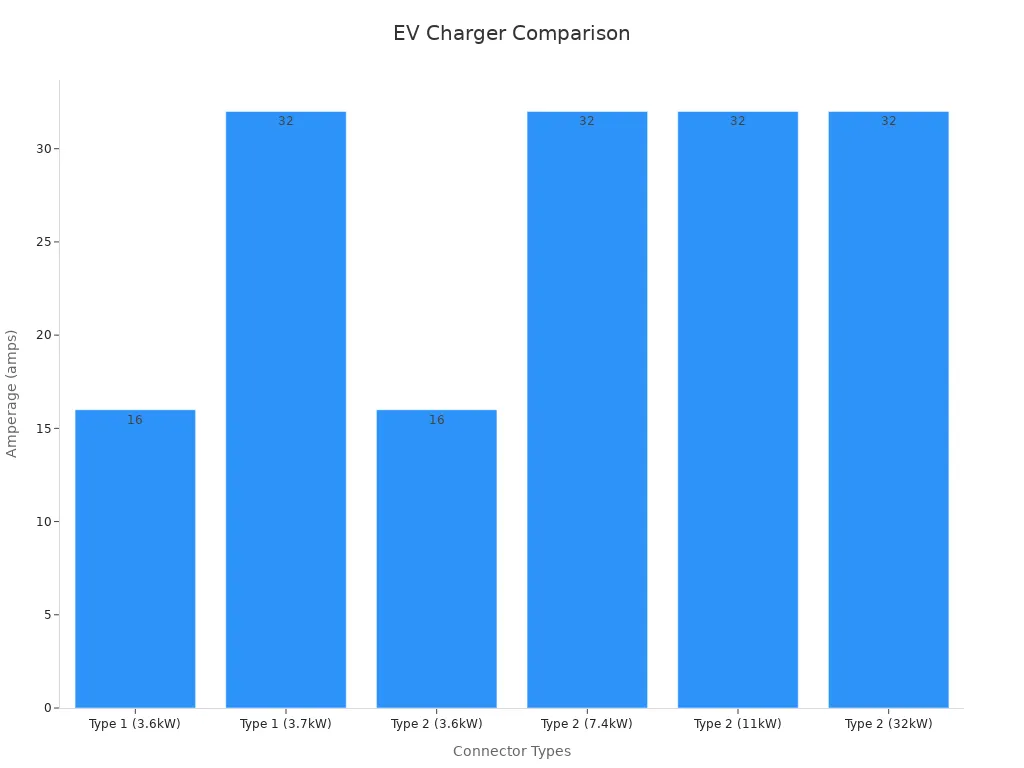
Here is a table that shows common connector types and cable details:
| Connector Type | Amperage | Phase | Cable Characteristics | Typical Cable Length |
|---|---|---|---|---|
| Type 1 (3.6kW) | 16 amps | Single-phase | Thinner, flexible cable | ~10 meters |
| Type 1 (3.7kW) | 32 amps | Single-phase | Slightly thicker cable | ~10 meters |
| Type 2 (3.6kW) | 16 amps | Single-phase | Standard or flexible cable | ~10 meters |
| Type 2 (7.4kW) | 32 amps | Single-phase | Thicker, less flexible cable | ~10 meters |
| Type 2 (11kW) | 32 amps | Three-phase | Thicker, less flexible, 5-core cable | ~10 meters |
| Type 2 (32kW) | 32 amps | Three-phase | Thicker, less flexible, 5-core cable | ~10 meters |
Most portable chargers use a 10-meter cable. This length gives you enough reach without making the charger too heavy or hard to store. If you have a larger vehicle or need to park farther from an outlet, you may want a longer cable.
Type 2 chargers are popular because they work with many cars and offer fast charging. They also have strong, weatherproof cables and safety features like RCDs and intelligent control boards.

Note: Using the wrong cable or connector can slow down charging or cause safety problems. Always match the cable and connector to your car’s needs.
A portable EV car battery charger with the right connector and cable length makes charging your electric vehicle easier and safer. When you choose a charger, look for features that match your car, your charging habits, and your parking setup.
Portability, Size, and Weight
When you choose a portable EV car battery charger, you want something that fits your lifestyle. Portability, size, and weight play a big role in how easy it is to use and carry your charger. Some chargers feel light and compact, while others are heavier and bulkier. The right choice depends on how you plan to use your charger.
Here is a table that shows how different types of transportable chargers compare:
| Charger Type | Weight Range | Dimensions/Size | Usability Impact |
|---|---|---|---|
| Level 1 Chargers | 5-10 pounds (2-4.5 kg) | Compact, fits in backpack | Lightweight and easy to carry; ideal for daily use and simple plug-in to 120V outlets. |
| Level 2 Chargers | 15-25 pounds (7-11 kg) | Bulkier, some over 2 feet long | Heavier and less grab-and-go; often require carrying cases or wheels; suitable for planned stops with 240V access. |
| Battery-Powered Units | Up to 50 pounds (23 kg) | Often wheeled suitcase size | Heavy, requiring wheels or strong physical effort; offers off-grid charging but less convenient for casual transport. |
You can see that Level 1 chargers work best if you want something light and easy to move. You can store them in your trunk or even a backpack. Level 2 chargers give you faster charging but weigh more and take up more space. Some battery-powered units let you charge without plugging into an outlet, but they are much heavier and harder to carry.
The design of a charger also affects how portable it feels. Look for ergonomic handles and cable management systems. These features make it easier to lift, store, and use your charger. If you travel often or need to move your charger between cars, a compact and lightweight model will save you time and effort.
Tip: Always check the weight and size before you buy. Make sure you can lift and store the charger easily in your vehicle.
Safety Features and Certifications
Safety should always come first when you use a portable EV charger. You want a charger that protects you, your car, and your home from electrical hazards. Reliable mobile EV chargers include many safety features that keep you safe during every charging session.
Look for these important safety features and certifications:
- Overcurrent protection stops the charger if too much electricity flows through it.
- Thermal protection monitors the temperature and shuts off charging if the unit gets too hot.
- Short-circuit protection prevents damage if something goes wrong with the wiring.
- Waterproof and dustproof designs keep the charger safe in rain or dirt.
Many chargers go through strict safety tests before they reach you. For example, Aptiv chargers receive independent third-party lab certifications, such as UL. This means experts test them for electrical, mechanical, and environmental safety. These chargers meet safety standards in over 100 countries. They also pass tests for vibration, extreme temperatures, and even misuse.
UL certification is one of the most trusted marks for safety. It checks every part of the charger, from the wires to the case. UL-certified chargers must pass tests for overcurrent and thermal protection. This gives you peace of mind that your charger will work safely, even in tough conditions.
Note: Always choose a charger with UL or similar certifications. This ensures your charger meets high safety standards and keeps you protected.
Durability and Build Quality
You want your portable EV charger to last for years. Durability and build quality show how well a charger stands up to daily use, travel, and harsh weather. Manufacturers test chargers in many ways to make sure they are tough and reliable.
Here are some real-world durability tests:
- Cold Weather Endurance: Chargers are placed in freezers at -9.5°F (-23°C) for almost two days. The cables stay flexible, and the charger works fine afterward.
- Drop Impact: Dropping the charger from waist height onto concrete does not break it. The charger powers up and works as expected.
- Automatic Restart: If the power goes out, the charger restarts by itself when electricity returns.
- Extreme Heat: Chargers are heated to over 122°F (50°C) and still charge cars for hours without shutting down.
- Water Submersion: Dunking the charger in water does not let any water inside. The charger stays dry and safe.
- Crush Resistance: Running over the charger with a heavy truck only scratches the paint. The charger keeps working.
These tests show that a well-built charger can handle almost anything. Look for chargers with strong cases, thick cables, and weatherproof seals. Good build quality means you can trust your charger to work in rain, snow, or heat. You will not have to worry about damage from drops or bumps.
Callout: A durable charger saves you money in the long run. You will not need to replace it often, and you can rely on it in any situation.
Ease of Use and Versatility
When you choose a portable EV car battery charger, you want something that makes charging simple and flexible. Many users say that AC portable chargers stand out for their compact size and easy portability. You can carry them in your trunk or backpack, which makes them perfect for travel, emergencies, or daily use at home.
- Many drivers praise how quickly these chargers set up. You just plug them into a standard outlet at home or on the road.
- People often mention that fast charging speeds help them get back on the road sooner, especially during road trips or when charging in remote places.
- Safety features like overcharge protection, thermal protection, and short-circuit protection give you confidence every time you use your charger.
- You will find that compatibility with multiple EV connectors, lightweight design, and extra features like temperature control or LED indicators make these chargers even more user-friendly.
- One driver shared a story about using an AC portable charger with a solar panel in a remote area. This setup provided reliable charging far from any public station, showing how versatile these chargers can be.
The J.D. Power U.S. Electric Vehicle Experience Home Charging Study also shows that owners of portable Level 2 chargers feel very satisfied. They rate these chargers almost as high as permanently mounted Level 2 stations. You will notice that ease of use, cord length, size, and storage all play a big part in this satisfaction. Portable Level 2 chargers give you a good balance between convenience and performance, whether you use them at home or take them on the go. Level 1 chargers, on the other hand, score lower because they charge much slower.
Tip: If you want a charger that works well both at home and on the road, look for a portable Level 2 model. You will enjoy faster charging and more flexibility.
Price, Brand Reputation, and Warranty
You want to get the best value when you buy a portable EV car battery charger. Price, brand reputation, and warranty all matter when you make your choice. Consumer Reports notes that most charging problems come from the vehicle’s onboard inverter or the cable that comes with the car, not from the home charger itself. This means you can focus on finding a reliable portable charger without worrying too much about brand-specific issues.
Here is a table that summarizes key points about price, warranty, and brand reputation:
| Aspect | Details |
|---|---|
| Price Sensitivity | Portable Level 2 chargers usually cost between $200 and $1,000. Installing a permanent home charger can cost $400 to $3,400. Incentives may lower your total cost. |
| Warranty | EV battery warranties differ. Some cover only total failure, while others include battery capacity loss. For example, Cadillac replaces the battery if capacity drops below 75%. Most batteries lose about 2.3% capacity each year. |
| Brand Reputation | Consumer Reports does not show major differences between portable charger brands. Reliability ratings focus more on the car than the charger. |
| Additional Notes | Experts recommend checking your home’s electrical system before buying a charger. This helps you avoid problems with compatibility or installation. |
You should compare prices and features before you buy. Portable Level 2 chargers often give you the best mix of speed and value, especially if you want to use them as your main home charger. Some brands offer longer warranties or better customer support, which can give you extra peace of mind. Always read the warranty details so you know what is covered.
Note: Before you buy, ask a professional to check if your home can support the charger you want. This step helps you avoid costly mistakes and ensures safe charging.
Types of Portable EV Chargers

AC vs DC Portable EV Chargers
You will find two main types of portable EV chargers: AC and DC models. Each type works differently and fits different needs. AC portable EV chargers use alternating current and usually offer Level 1 or Level 2 charging. These chargers work well for home use or public places like supermarkets. DC portable EV chargers use direct current and deliver much faster charging, often called Level 3 or fast charging. You will see these at rapid charging stations or in mobile setups for quick top-ups.
Here is a table to help you compare AC and DC portable EV chargers:
| Criteria | AC Portable EV Chargers (Level 1 & 2) | DC Portable EV Chargers (Level 3) |
|---|---|---|
| Current Type | Alternating Current (AC) | Direct Current (DC) |
| Power Capacity | 3 kW to 22 kW | Starting at 50 kW, can exceed 100 kW |
| Charging Speed | 8-12 hours for full charge | ~20 minutes for 80% charge |
| Conversion Process | AC converted to DC by your car | DC goes straight to your battery |
| Typical Use Cases | Home, public slow/fast charging | Rapid public charging, mobile fast charging |
| Cable Configuration | Tethered or untethered | Usually tethered |
| Market Prevalence | Common in homes and public places | Found mainly at rapid charging stations |
| Example Controllers | Single/double gun, 7.4kW to 22kW | CCS2 controller, high-power units |
Tip: If you want fast charging on the go, look for a DC portable EV charger. For daily home use, an AC portable EV charger is usually enough.
Consumer vs Commercial Portable EV Chargers
You can choose between consumer and commercial portable EV chargers. Consumer models work best for personal use. They are smaller, lighter, and easy to carry. You can keep one in your trunk for emergencies or daily charging. Commercial portable EV chargers are larger and more powerful. Businesses use them at events, car dealerships, or as mobile electric vehicle chargers for fleets. These chargers often support multiple vehicles and offer higher charging speeds.
-
Consumer portable EV chargers:
- Lightweight and compact
- Easy to use at home or on trips
- Lower power output, but enough for most drivers
-
Commercial portable EV chargers:
- Heavy-duty and robust
- Designed for frequent use and multiple cars
- Higher power output, sometimes with DC fast charging
Note: If you run a business or manage a fleet, a commercial portable EV charger can help you keep all your vehicles ready.
Use Cases for Different Portable EV Chargers
You will see many ways to use portable EV chargers. Some cities use mobile charging stations to boost fixed charging station performance. In Chattanooga, mobile charging stations improved operations by over 60% and increased profits by almost 50% with smart pricing. You can find three main types of mobile charging solutions:
- Truck Mobile Charging Stations (TMCS): Trucks or vans with built-in batteries. They drive to where you need charging and refill their own batteries at depots.
- Portable Mobile Charging Stations (PMCS): Units you can tow or carry. You place them where needed for temporary charging, such as at events or in remote areas.
- Vehicle-to-Vehicle (V2V) Charging: One electric car charger shares power with another EV. This method uses cloud systems to manage the process.
Automakers now offer robot-like mobile charging units for parking lots. These can deliver up to 50 kW DC fast charging. You benefit from less waiting and more flexible charging locations. Mobile electric vehicle chargers also help reduce range anxiety and support areas with few fixed stations.
Callout: Portable EV chargers give you more freedom. You can charge at home, on the road, or even share power with another EV.
Common Concerns and Limitations of Portable EV Car Battery Chargers
Range, Charging Time, and Amperage Compatibility
You may wonder how far you can drive before needing to recharge. Portable EV chargers help, but you still face some challenges. The table below shows common issues you might experience:
| Aspect | Verified Performance Data / Market Insight | Impact / Challenge Description |
|---|---|---|
| Range Anxiety | Limited charging infrastructure, especially in rural/underserved areas, restricts effective use of portable chargers. | Causes EV owners to worry about running out of charge, limiting reliance on portable chargers. |
| Charging Time | Level 1 (standard) chargers are slow; Level 2 (240V) chargers offer faster charging (3.7 kW to 7.4 kW medium power range). | Faster charging reduces downtime but Level 2 chargers may have cost and compatibility barriers. |
| Amperage Compatibility | Variability in charging standards and EV model compatibility; not all portable chargers fit every EV. | User frustration and limited appeal due to incompatibility issues. |
| Power Output Segmentation | Chargers segmented into Low (up to 3.7 kW), Medium (3.7-7.4 kW), and High (>7.4 kW) power. Medium power balances speed and cost. | Medium power chargers growing due to balance of charging speed, affordability, and broad EV compatibility. |
| Charging Infrastructure | Portable chargers connect to household outlets or higher voltage sockets; some have adapters for public stations. | Provides backup charging options but limited by availability of compatible outlets and infrastructure. |
You need to match the charger’s amperage to your car’s needs. Not every charger works with every EV. Charging speed also depends on the outlet and the charger’s power. If you travel long distances, you may still worry about your range.
When a Portable EV Charger Is (and Isn’t) Necessary
You do not always need to carry a portable charger. The table below helps you decide when it is essential:
| Dimension / Process | Description | Relevance to Portable EV Charger Essentiality |
|---|---|---|
| Scenario | Different charging contexts: home, workplace, public stations, long-distance travel | Portable charger essential in long-distance travel or lack of nearby infrastructure; less essential with home/workplace access |
| Time | Temporal factors: time of day, day of week, season | Influences charging cost and availability; portable charger useful when off-peak or unpredictable timing is needed |
| Space | Geographic location, distance to charging stations, station availability | Portable charger critical when stations are distant or unavailable |
| Energy | Battery capacity, state of charge, charging speed | Larger battery needs or low state of charge increase portable charger necessity |
| Price | Electricity cost, time-of-use tariffs, incentives | Economic factors affect decision; portable charger may be preferred to avoid high prices or peak tariffs |
You should bring a portable charger if you plan a road trip, visit remote areas, or want an emergency charging solution. If you always charge at home or work, you may not need one.
Limitations Compared to Fixed Charging Stations
Portable chargers give you flexibility, but they have limits. Fixed charging stations often provide faster charging and more power. You may find that portable chargers have shorter cables and lower weatherproof ratings. Some portable chargers do not support smart features like Wi-Fi or app control. You also need to check if your outlet can handle the charger’s power. Upgrading your outlet may require an electrician.
Tip: Portable chargers work best for travel, backup, or as an emergency charging solution. For daily use at home, a fixed station may offer more convenience and faster charging.
Making the Right Choice: Selecting the Best Portable EV Car Battery Charger
Matching Key Features to Your Needs
When purchasing a portable ev charger, you want to make sure it fits your daily routine and your electric vehicle. Start by checking the amperage. Some chargers let you adjust the amperage, which helps if your power supply at home is limited. Next, look at compatibility. Your charger must match your car’s connector type, like Type 1 or Type 2. Cable length matters, too. Measure the distance from your parking spot to your power outlet at home so you do not end up with a cable that is too short.
Portability is important if you plan to carry your charger between locations. Lightweight chargers with carrying cases make travel easier. Safety features protect both your vehicle and your home. Look for overcurrent, overvoltage, and overheat protection. Here is a simple checklist to help you match features to your needs:
- Amperage: Choose a charger with adjustable settings for different power supplies.
- Compatibility: Make sure the charger fits your car’s connector.
- Cable Length: Pick a cable that reaches from your outlet to your car.
- Portability: Select a lightweight model if you travel often.
- Safety Features: Check for built-in protections.
Tips for First-Time Portable EV Charger Buyers
If you are purchasing a portable ev charger for the first time, you should compare models and safety ratings. The table below shows some popular options:
| Charger Model | Voltage & Amp | Plug Type | Charging Speed | Certifications | Price |
|---|---|---|---|---|---|
| Lectron Portable Level 1 & 2 J1772 EV Charger | 110V & 240V, 12A & 40A | NEMA 5-15 & 14-50 | Up to 9.6 kW | ETL & FCC, IP65 weatherproof | $309.99 |
| Lectron Portable Level 1 J1772 EV Charger | 110V, 15A | NEMA 5-15 | Standard Level 1 speed | ETL, IP65 weatherproof | $127.99 |
| Lectron Portable Level 1 Tesla Charger | 110V, 15A | NEMA 5-15 | Standard Level 1 speed | ETL, IP65 weatherproof | $157.99 |
You should always have a certified electrician check your home’s electrical panel before installing a home charger. Never use a dryer outlet for your charger. Choose products from trusted brands with strong warranties and safety certifications. Keep your charger clean and inspect it for damage. If you want more convenience, look for smart features like scheduling and remote monitoring.
Tip: Portable EV chargers help you charge at home, on the road, or during emergencies. They give you freedom from public charging stations and help you avoid long waits.
When purchasing a portable ev charger, think about your charging speed needs, your car’s compatibility, and how often you will move the charger. These steps will help you make a confident choice and enjoy safe charging at home or anywhere you travel.
When you choose a portable ev car battery charger, focus on safety, compatibility, and charging speed. Look for a model that matches your car and fits your daily routine. Check for strong warranties and trusted certifications. Remember, a good charger gives you freedom and peace of mind.
Take your time, compare your options, and trust your research. You can make a smart, confident choice for your EV charging needs.
FAQ
How do you know if a portable EV charger works with your car?
Check your car’s charging port and the charger’s connector type. Most EVs use J1772 or Type 2 connectors. Read your car’s manual or ask your dealer for help. Always match the charger to your car’s requirements.
Can you use a portable EV charger in the rain?
Yes, most portable EV chargers have weatherproof designs. Look for chargers with IP ratings like IP65 or IP67. These ratings mean the charger can handle rain and dust. Always follow the safety instructions in the user manual.
How long does it take to charge your EV with a portable charger?
Charging time depends on the charger’s power and your car’s battery size. Level 1 chargers may take over 24 hours for a full charge. Level 2 chargers often need 4 to 10 hours. Check your car’s specs for exact times.
Is it safe to leave your portable EV charger plugged in overnight?
Yes, you can leave most portable EV chargers plugged in overnight. Built-in safety features like overcurrent and thermal protection keep you safe. Always use a certified charger and follow the manufacturer’s guidelines.
What should you do if your portable charger stops working?
First, unplug the charger and check for visible damage. Try a different outlet. If it still does not work, contact the manufacturer or a certified electrician. Never try to repair the charger yourself.


